
Measurement with Improvement: Teachstone’s Perspective on the Proposed Head Start Regulations
CHARLOTTESVILLE, Va., October 16, 2026 — The Administration for Children and Families (ACF) recently published a Notice of Proposed Rulemaking (NPRM) aimed at reducing federal burdens for Head Start programs. Teachstone supports efforts to increase local flexibility and reduce unnecessary administrative strain. At the same time, our decades of research and experience working alongside Head Start programs reinforce the importance of maintaining a clear, shared understanding of classroom quality while strengthening how measurement supports meaningful improvement.
Our official public comment reflects years of working with Head Start educators, local program leaders, state administrators, and federal staff. We’ve consistently heard that relying on a single aggregate, point-in-time CLASS score for automatic high-stakes consequences has limited programs’ access to, and ability to use, reliable data to drive meaningful improvement.
Head Start has long been a leader in recognizing the importance of educator-child interactions. This is an opportunity to build on that foundation by better connecting measurement, accountability, and ongoing support, locally and frequently, to improve children’s experiences.
Key Highlights from Our Public Comment
- Interactions are the strongest predictor of learning: A landmark multi-state study found that educator-child interactions measured by CLASS were the strongest predictor of children’s academic and social-emotional skills, outperforming class size, child-to-staff ratios, staff qualifications, family partnerships, and the overall learning environment.*
- Removing standards creates regulatory gaps and increases uncertainty and risk: Without regulatory standards, grant recipients must resolve federal evaluation and compliance questions on their own. Shared measurement tools, reliable observers, and common data standards prevent fragmented expectations and outcomes. The proposed rule creates confusion by removing definition and methodology standards and risk by not specifying observer qualifications, scoring methods, or interrater reliability safeguards.
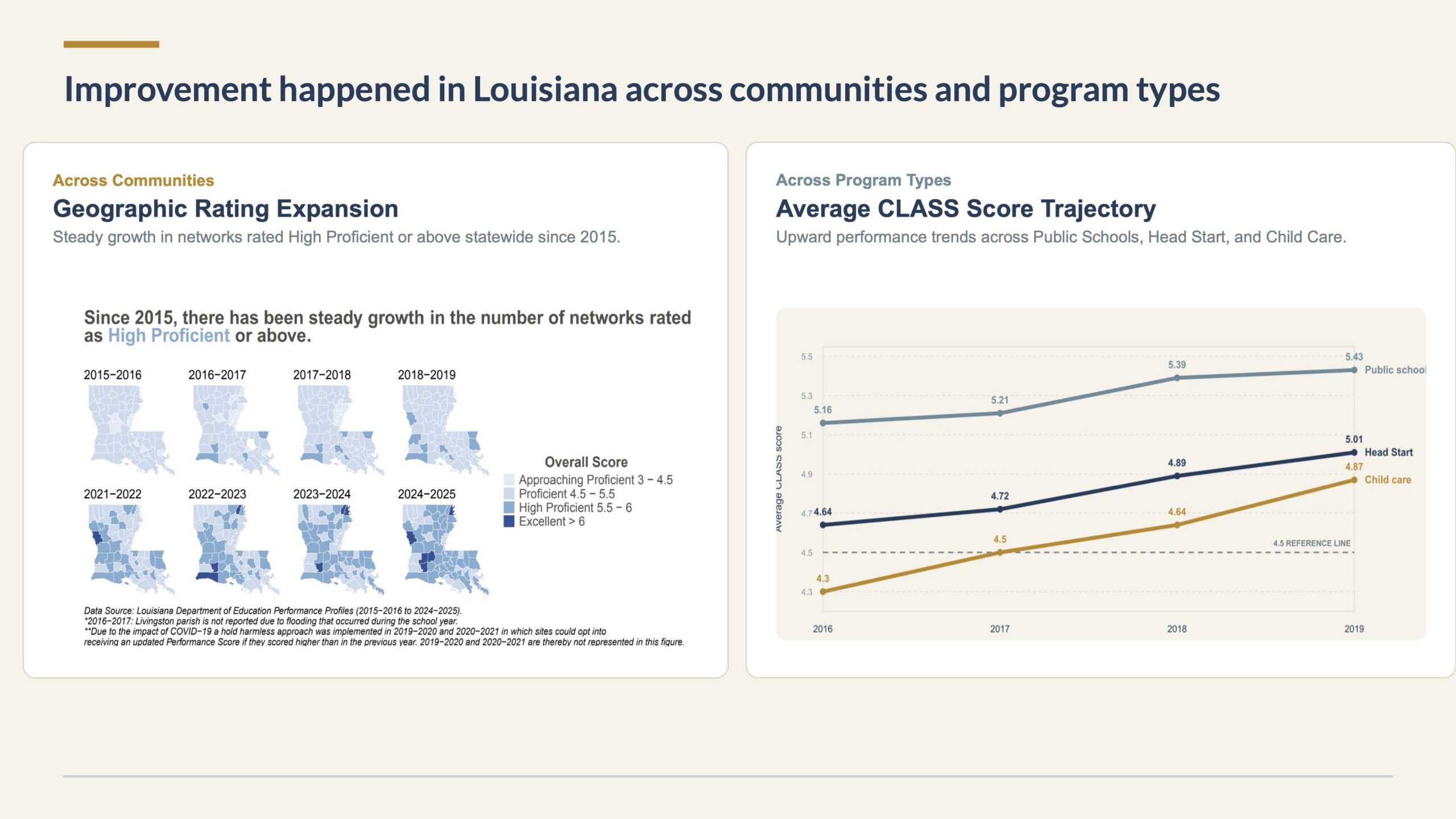
- Proven improvement at scale with CLASS: Louisiana illustrates how CLASS can support systemwide improvement when implementation gives local programs ownership of the process and access to meaningful data to guide their decisions. Under this approach, the percentage of Head Start programs meeting state proficiency standards rose from 61% in 2016 to 93% in 2019. (see Exhibit A)
Core Recommendations for ACF
Rather than removing CLASS® provisions entirely, Teachstone asks ACF to modernize how quality measurement, support, and accountability work together to support children’s outcomes:
- Retain CLASS® as the established observational measure in Head Start Program Performance Standards while maintaining transparent statutory criteria for qualifying additional valid, reliable, and research-based measures over time.
- Retain and implement a data-driven quality baseline for a Designation Renewal System (DRS) improvement sequence clarifying how improvement relates to thresholds.
- Strengthen federal support obligations: Retain and expand federal requirements that directly connect observed classroom needs to technical assistance and local professional development resources.
- Replace automatic recompetition based on a single point-in-time score with a clear improvement pathway: A single low aggregate score should not automatically trigger recompetition. Instead, it should initiate a required improvement path featuring targeted coaching, professional development, follow-up measurement, and accountability for persistent low performance, including disengagement.
- Issue a separate NPRM focused on DRS and Partner with qualified state systems: Create a dedicated rulemaking process for monitoring and DRS that engages state and local partners in reforming accountability. Recognize state and local quality systems that meet federal standards, reducing duplication and providers’ administrative costs.
By maintaining a shared, evidence-based quality standard and pairing it with meaningful improvement pathways, federal policy can protect high-quality classroom experiences that support children’s school readiness and positive lifelong outcomes, while honoring the needs of local educators and program leaders.
Looking Ahead
As ACF reviews the thousands of public comments submitted across the country, Teachstone remains committed to working alongside Head Start programs, policymakers, and early childhood partners to advance policies that support both program quality and educator well-being. No matter how the regulatory details are finalized, our focus remains on providing educators with the tools, insights, and support they need to create supportive learning environments every day.
Read our full comment here.
Questions? Contact [email protected]
*Sabol, T. J., Soliday Hong, S. L., Pianta, R. C., & Burchinal, M. R. (2013). Can rating pre-K programs predict children’s learning? Science, 341(6148), 845–846.